Clipping: Everything you were afraid to ask

I’m on a roll at the moment, and enjoying sharing all my useful knowledge with you. Hopefully you’ve checked out my handy winter prep sheets and headed over to YouTube for the tutorials on there.

Today, I want to focus on clipping. I’ve been doing a little series on YouTube and thought that it would be a great winter topic for the blog , so here we are.

Getting the basics right

The first time I clipped a horse from start to finish at work, I was handed a set of clippers and told to crack on. I had clipped horses before so was confident in that respect. What I hadn’t ever done was set the clippers up. Someone had always done that, then let me have a go. It’s something that you can read about but unless you actually have watched someone do it and taken note of what they do then it can be daunting.

I was worried that I had put the clippers together wrong, that I had over tightened the blades, was I even putting the oil in the right holes. All of these questions are answered in this video that I have made to make clipping a horse for the first time on your own much easier and less stressful.

Which clip is best for a beginner?

Clipping over time has become less stuffy than it was back when I started clipping horses. People are now much more happy to do a clip that suits there horse, rather than follow fashion. And I am all in favour of this, just because sometimes doing something that does not feature in the usual clipping lines actually is really good for your horse. You should base the clip you want to do on the following 3 factors:

  • Level of work the horse is in
  • Body condition of the horse
  • Environment the horse is kept in

Giving a horse that lives out 24/7 with no shelter that does not keep weight on well and is only going for hacks at the weekend a full clip because it looks cool is not in the best interest of that horse’s welfare.

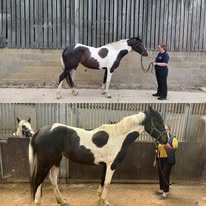
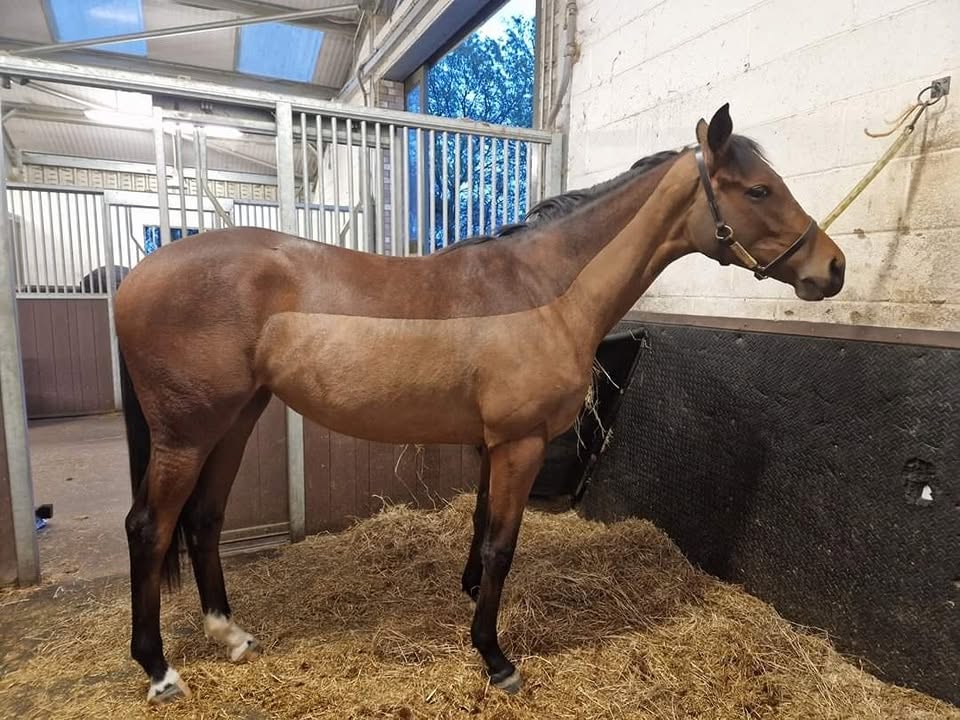
I have at time also adapted traditional clips to a look that is better for that horse, especially with young Thoroughbreds. The rise of the yearling clip which enables you to clip most of the hair off without risking getting kicked in the head and leaves enough hair on to help riders on those fresh winter mornings is actually a great idea (see below)
Keep it simple!

When attempting to clip for the first time I have two clips that I would recommend – either a trace type clip or a hunter. These are relative easy and don’t take too much time. The trace is a bit harder as you will have to do lines but you start from in front of your horse’s stifle or even their girth area and draw a line up to their ears. If you don’t get it even both sides, it won’t show too much. Even easier is to do a hunter clip if your horse is good to clip and in full work. Clipping all the hair off in one go is much easier than fiddling about with lines!

Clippings tips that no one ever tells you

Clipping is something that really does just take lots of practice, getting it wrong, getting hair in places you don’t want to and thinking ‘oh well, it will grow out’. If you keep in mind the difference between a good clip and bad one is just two weeks, then you will be half way there.

I do have some tips that I wished I’d been told sooner:

  • Wash your horse before – a clean coat is easier on the blades and gives a smoother finish.
  • Wear overalls – Future you will thank you when you’re not finding hair in your underwear for weeks afterwards.
  • Have multiple sets of blades – swapping hot blades for cool ones makes the whole job quicker.
  • and use baby wipes – they are brilliant for getting clipped hair off your horse, your hands and your face.

In this video, I show you why:

https://youtu.be/lOEQeEuQvcw

Not sure which clip suits your horse or want a second pair of eyes?

Every horse is different, and it can be hard to know which clip to choose or how to get through winter without it all feeling overwhelming. If you’d like some personal advice, you can book a £10 call with me to talk through your horse, their workload and what they need this winter. I also offer consultations on horse care, rehabilitation and retraining, breeding and foaling, and confidence.

Come and join me live on Wednesday

I’m going live on Facebook on Wednesday 18 November at 7pm, and I’d love you to join me. Bring your questions and I’ll answer as many as I can.

More help for your winter

  • Grab my free winter prep sheets if you haven’t already: Here
  • My book, The Simple Guide to Horse Care, covers everyday care in one place: https://amzn.eu/d/0eEQvdbR

I hope you’ve enjoyed this blog, which brings together the work behind the YouTube series. If you’d like to see more tutorials like these, let me know in the comments or send me a message. And if you’ve found it useful, please subscribe and give the videos a like, as it really does help me.

Happy clipping!
Feeding Horses in Winter: Better Choices That Don’t Cost the Earth

I hope you have been enjoying this series on coping with the pressure of the winter for horse owner. This series is reflective of how I want the website to develop. Helping provide good quality, science backed advice that does work. Owning horses is not cheap but you can make better choices that don’t cost you the earth. If you missed my free check list you can get it here –

Feeding horses in winter is an area that you can do well to pay extra attention to. Whether you’ve got a good doer or a skinny minnie, then this blog is here to help you navigate the winter months more effectively.

I’m going to concentrate on three main areas:

  • Type of feed needed
  • Bulking out your feed effectively
  • Controlling the cost of winter feed

Start with the horse, not the bucket

Feeding horses is both a science and an art. The best place to start is to look at the horse, rugless. To help you can take a photo from both sides, front and back. Keep these and compare them monthly or so.

There are a number of very good source of body scoring that you can use to assess your horse’s body condition without weighing them. The British Horse Society has a really good resource on doing this – you can find it HERE. I’d say body scoring is the most reliable unless you have access to a weighbridge on site.

What Feed you will need

Forage is the base of the winter feeding and our biggest cost, so it is particularly important to have a good grip on.

Good doers are a nightmare in summer but a godsend in winter. If your horse is holding their condition well on hay and a heavily chaff based feed alone, then stick to that. Adding in a concentrate feed will only cost you money and give you a problem in the spring.

Conversely if your horse is on the lighter side, then concentrate on checking everything is good with them healthwise first – are their teeth checked and is there a worm issue? Before reaching for that bag of conditioning mix.

For both types, there are plenty of forage based options for either type. Look for low sugar/starch options like chopped straw products for the good doers. For the skinny minnies, look at chaffs with high oil and protein additions.

I went through this live, and you can watch it back here.

How to bulk out your feed effectively

fff This is the practical section people share. Cover chop, soaked fibre feeds and unmolassed beet, safe soaking times and amounts, and how to bulk out a small ration to keep a greedy horse occupied. If you use slow-feed nets, mention them as a way to stretch forage. Keep the scientific “why” short, such as how fibre keeps the gut working and slows eating.

Controlling costs

By nature, we are often a bit guilty of being ‘feeders’ but in this current climate it is vital to savvy with your feeding routine. Start to weigh your feed, weigh your hay nets or the portion of hay or haylage that you are putting out/in your stable. This will enable you to know how much you are using and how this correlates with what your horse actually needs. It also will enable you to work out how much it is costing you.

Along as being feeders, it is easy to try to be blind to just how much you are spending on your horse. There are some cheap wins that will help you save all year round, not just this winter!

  • Buy forage well ahead of needing it.
  • Buy in bulk, while this might be a bit scary, if you have the space then it will save you a lot.
  • Share loads with friends.
  • Ensure your feed storage is dry and vermin free to avoid wastage.
  • Feed by weight, not by scoop – this will save you far more money than you will realise.
  • Drop supplements that are not working or are doubled up.

In addition to cheap wins, there are also false economies to avoid –

  • Cheap feed does not always equal good food and you can end up needing to feed more and then end up living in a false economy. That said, do your research, most of the big feed companies have a value line that they sell as own brand feed in feed stores like Mole Valley Stores.
  • Feeding hay on the ground in the field – this will trash your grazing and the horses only eat a little before wasting it.

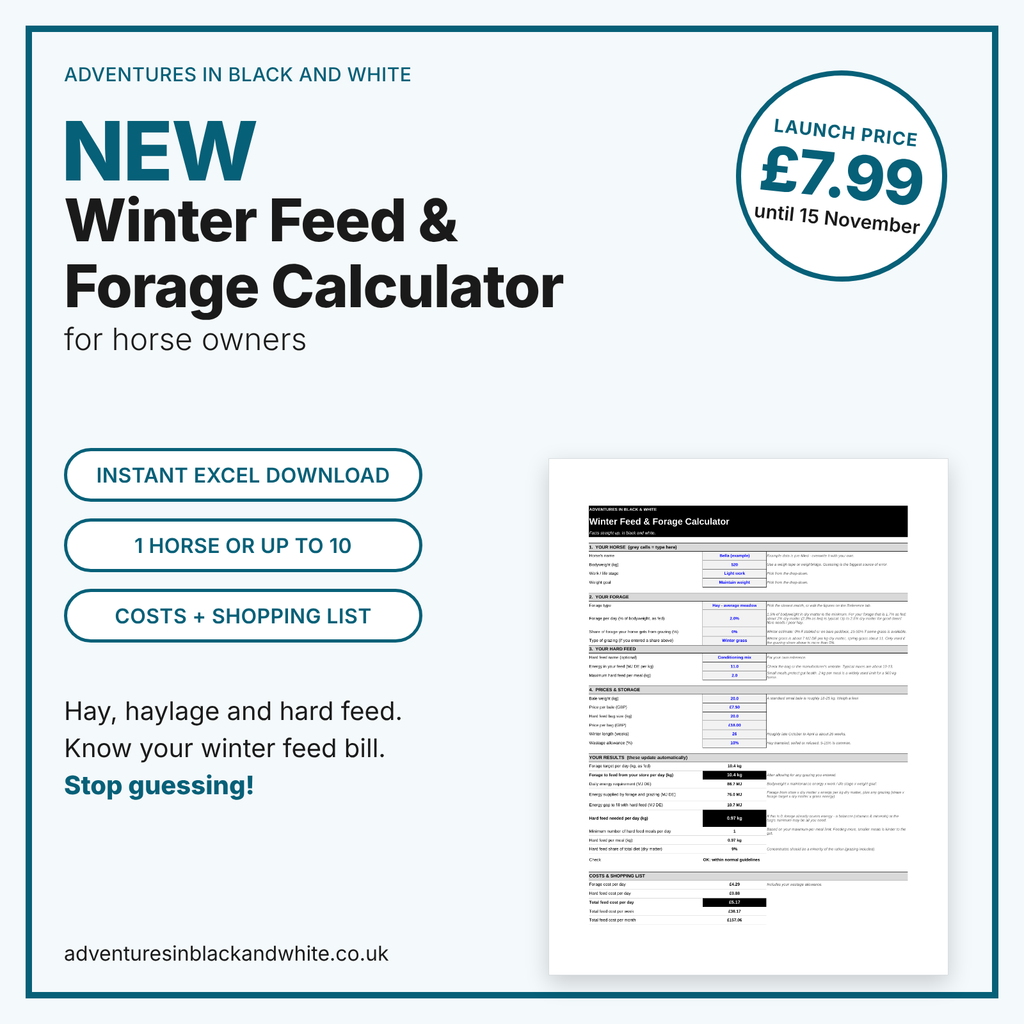
The Adventures in Black and White Feed Calculator

I’ve designed a winter feed calculator to take the guess work out of feeding. This great spreadsheet will work out how much your horse needs on a daily basis and will even give you the cost so you can budget for winter.

← Click image to go to shop

Wrapping it all up

This is the last in this current series, I hope you have enjoyed it and do watch the full Live. You can catch up either on Facebook or on YouTube.

Remember to pick the problems you can control, one from the three areas – one thing that will make it easier on the yard, one thing that will make winter more pleasant for your horse and one thing that will help you. Then you can build from there!

Want more help? Winter Help includes tailored advice on your horse, your land and your routine, a video call of up to an hour each month, and WhatsApp support with replies within 48 hours (£45, or £35 with a First Winter Chat discount). Whole Winter runs from 1st November or 1st December for 3 months (£120).

Your enquiry could not be saved. Please try again.
Thanks, your enquiry has been sent. I’ll reply within 2 working days, and I’ve emailed you a confirmation. If you can’t see it, check your junk folder. If your horse is ill or injured, please call your vet first.

Help Form

Tell me a little about you and your horse and I’ll come back to you within 2 working days.

We work with Brevo to collect your data and send you our communications. As part of this, Brevo acts under our responsibility and our instructions — we remain responsible for how your data is used for this purpose. Brevo may also, on its own side, use some of this data to help keep the platform secure (for example, to spot attempted fraud or hacking) — to find out more about this part, see Brevo's Privacy Policy.

My advice comes from my experience and equine science qualifications, and it doesn’t replace your vet. For any health concern or emergency, call them first.

A Random Rosette, YouTube and Equestrian Books

Rosette and Log Books

Welcome to my latest catch up, October was always going to be a funny month with the surgery going on. It didn’t stop me getting back into YouTube though. I also used my annual leave to get cracking on some new books on Amazon ready for Christmas. The best bit was the random rosette that arrived in the mail but I’ll get onto that later.

The Stormy Update

So Stormy has had a really nice time, while I have been off having surgery. My lovely friends looked after her so well. Last week we moved her to my trainer’s yard so she can start work again. Sarah was away so I was house sitting while on annual leave. Never one to waste time, I gave her a spin on the lunge to see how she was feeling and if I was up to working her. She was thankfully really quite good – as shown below

So next up for her is to get me on, I have had the all clear to ride but am going to leave it another week. Sarah is going to work her next week so she should be on top form to get on next Saturday. I am so excited about that!

She is still living out which is good for her and have become a total fluff ball so we are going to have to get someone to clip her. I would normally do it myself but with my shoulder still in recovery, it is better to pay someone to come and do it.

New Equestrian Books on Amazon

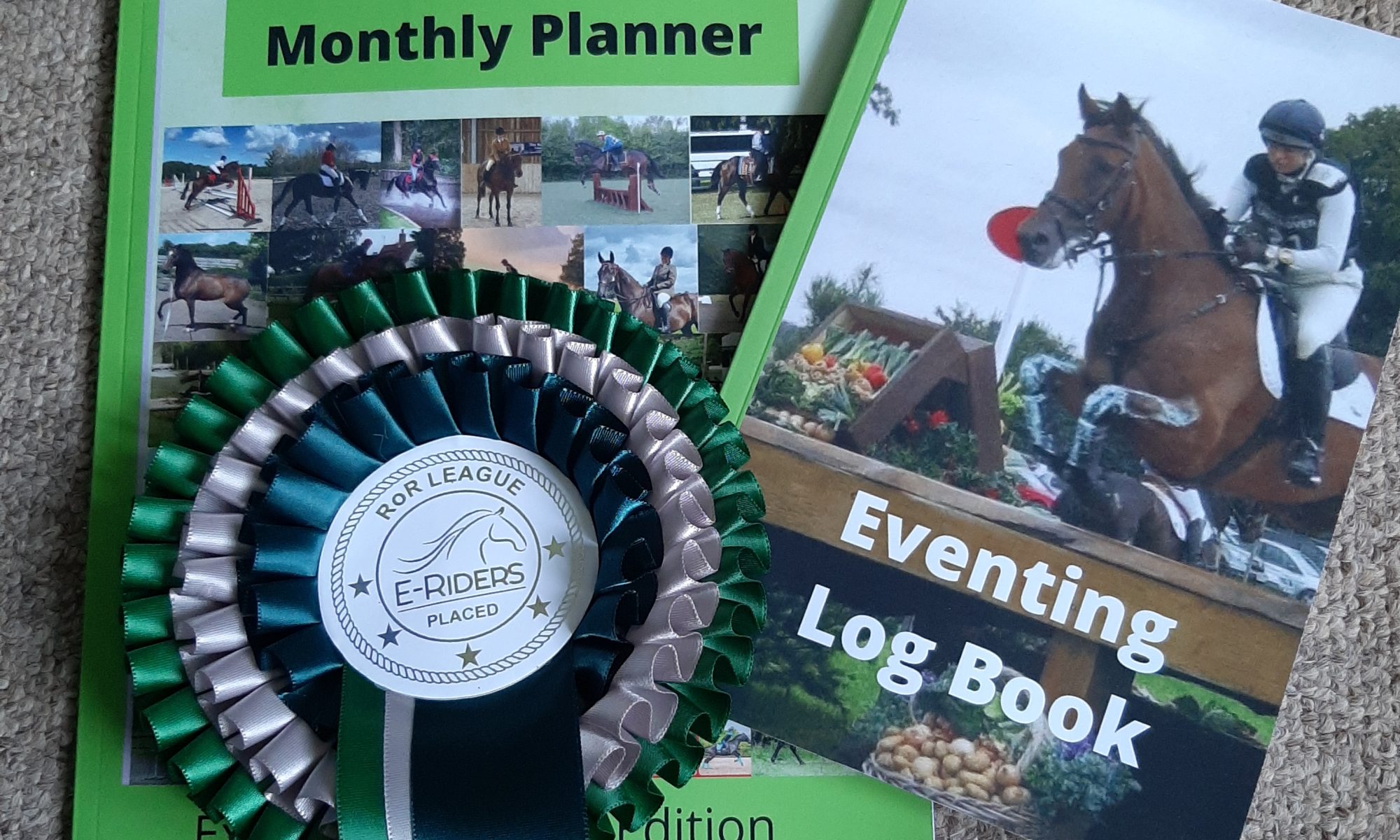
I had a few ideas planned for books to publish to compliment the series that I already have on Amazon. So I decided to run a competition on my Facebook page and on an Ex-Racer group to look for a cover star to feature on a purely Ex-Racer themed log book. I designed a whole new interior and popped up the post. I was totally blown away by the entries, I had around 200 different pictures to chose from.

At that point I decided that I would have two cover stars, one flat, one jumping and then with the best of the rest I would make a monthly planner for ex-racers. The winners for the cover star competition have both received their log books and I hope that they are pleased with the results.

The Ex-Racers 2022 Monthly Planner came together too really nicely and I like it. I’ve already sold a few copies and I hope that those that feature do decide to buy a copy as it’s really nice memento to have.

I have now expanded my Equestrian book range to include hardbacks and 2022 Monthly Planners. I also have a Wordsearch puzzler book that is now ready and a more detailed 2022 diary to work on.

October YouTube Tutorials and Vlogs

So I have been doing more catch up Vlogs in October for my YouTube channel and Tutorials. As I had said in my last blog, I had a lot of video content that was just waiting to be processed. This is definitely the way forward. Each week I am alternating between a Vlog update and a tutorial and it is slowly driving traffic and subscribers.

My latest Tutorial is below and you can catch up anytime by visiting the channel. I am enjoying doing the mini what’s going on Vlogs to check in. My next one will be super exciting!

A Random Rosette

I came home on Friday to find a random package from E-Riders. Having not done any tests since May so was surprised to find a rather large rosette inside! It appears that Stormy and I came 7th in the RoR Intro League which has just finished. It was a lovely surprise and really cheered me up!

We do plan to do more online dressage once I am back fit and I think that I will stick with just E-Riders for now as I am trying to save for a trailer to go out for real competitions. Both companies that I had used were good but I like the league structure better with E-Riders. It was fairer for Stormy to be competing against her own breed.

October Catch-Up Conclusion

So that is it for now. I will have another blog coming out next week but thought it was a good time to just update on what I have been up to. As I have been very busy! With Christmas coming up, I am very keen to promote my books as I think they make presents. So head over to the Journals and Log Books page for more information on how to buy. Every little helps to help fund Stormy’s training!

YouTube: An Update

Just over a year ago I wrote on here that I was going to knuckle down and do more with my YouTube channel. And to an extent I think I have done really quite well with it. Views are good, some do very well. I do really need more subscribers, so if you haven’t done already do subscribe. It doesn’t cost a penny and once I get to 1000 then I do get rewarded for the effort put in.

Currently my channel is largely three main areas; Dressage tests – for now there are not many being uploaded but once we get out and about I am going to make sure I bully someone into videoing every test! Tutorials – these are taking off, I am very keen to share all my experience gained over the last 20 plus years working with horses, particularly in Stable Management. Finally mini Vlogs, where I update what I am up to, which at the moment is mostly fixing my shoulder!

I have catalogued all my YouTube Tutorials on this site as a handy way to come and find the tutorial that you need.

Stable Management Tutorials

This is a topic that I feel is much neglected. Good stable management is the key to a health horse. And a health horse is a happy horse. All my stable management videos can be found here.

Tack and Equipment Tutorials

Ever wondering how you actually fit a bridle? Which exercise sheet do you really need? If so on this page I am building a whole range of basic tutorials that anyone can follow.

Get Involved!

I am always open to suggestions for future YouTube Tutorials. Please pop a note in the comments and subscribe to my page. I will then let you know when I have made a tutorial of your request or when I intend on doing so. I would love for this page to be more interactive so don’t be shy. Sign up! And don’t forget to subscribe to the YouTube channel to help me create more content.

Guide: My 10 Steps to Stress-free Summer Washing

Welcome to my 10 steps for stress-free summer washing. As the owner of grey horses for 20 years, I would consider myself very experienced in washing horses. And that’s before I count how many horses I washed while working professionally with them! The key to keeping the whole experience as quick and relaxing as possible is to prepare.

1 – Collect your washing kit

Having a grey horse and working full time means that I have had to stream line my washing kit. I keep it super simple for a summer wash, which is different to a show wash (hopefully one of those will come up soon). I aim to wash Nickel at least every fortnight if we are not competing so the summer wash is cold water simple wash. With Murphy, who was the dirtiest horse known to man, we often washed him twice a week or more.

Below is my basic kit which I keep together so I don’t need to be scratching about looking for missing items –

I use cheap supermarket shampoo, my favourite being Tesco’s Apple and Aloe Vera, mostly because it is cheap and I have yet to find a horse that is allergic to it. I also buy car sponges from where ever is cheapest as they are the best value. Usually B&M or Poundland. In my opinion sponges from the tack shops are just over priced for what you end up doing with them. I have over the years bought very expensive horse washing mitts etc but still I go back to my sponge. For heavy stains/ground in mud I use a Magic Brush. I also have a large bucket with I only ever use for washing horses, this is for hygiene reasons. Again as with the sponges, your best bet is to buy from a place like Homebase or B & Q rather than from a tack shop.

2 – Groom the Horse

This may sound silly but I always groom before I bath, mostly to remove as much mud or dust before I start which makes the job so much easier. Just a quick knock over with a magic brush, then do the mane and tail, before removing all the dust etc with a good dandy brush.

3 – Wet the Horse

It is far easier to get the shampoo into the coat if you prewash with water first, it just seems to let the shampoo ‘stick’ better. Nickel is good boy and lets me hose his head, but you may want to use a sponge to get the head wet. This is an area often missed and their heads are super greasy!

4 – Apply the Shampoo

I prefer to put the shampoo in the bucket and add water to it. I use the sponge to rub the soapy water all over the horse, being careful not to get it in their eyes.

5 – The Mane and Tail

I pay particular attention to the mane and tail as these get really greasy and scurfy if neglected. So, I do tend to use neat shampoos on these areas and really massage it in.

6 – Rinse

It is really important to rinse the whole horse really well. I will sometimes rinse and scrape twice is I am not sure that I have got all the shampoo out. Again, a hose job really, all over paying lots of attention to the mane area as this has neat shampoo on.

7 – Scrape of the Excess Water

Unless the horse is really hot, then when washing I will scrape the water off using a metal sweat scraper on the body and bailer twine on the legs and belly. The bailer twice trick was taught to me in the riding school and it is the best method to get excess water off tricky lumpy areas. Simply have a clean long piece of bailer twice. Take each end in either hand and pull tight. Then pull this over the horse’s coat including on the legs with as hard a pressure as they will take. The water literally falls off. Just give it a go!

8 – Application of treatments

At this point I will spray the tail with show sheen and the mane too if I am not planning on plaiting or pulling before the next wash. My preferred product is Canter Mane and Tail Conditioner, which is long lasting and smells nice. As it’s a summer wash this is also the time, I would apply fly spray if needed. I have always found white greys to be fairly self-repellent to flies. Therefore, I do not tend to use a lot of fly spray. However on dark coloured horses it has been vital.

9 – The Tail

The last thing before I finish the wash that I will do is to brush out the tail completely. As this stage with the show sheen soaked in, the tail will be very easy to brush out. I don’t believe in brushing tails too often as it ruins them. In the winter, I plait them up at all times unless they are competing to keep them cleaner.

10 – Finish

So as it’s summer comfort wash, the next thing to do is turn out your horse and cry as they roll in the dust……..

Nickel didn’t roll in the dust as he likes to be sparkly unicorn!