

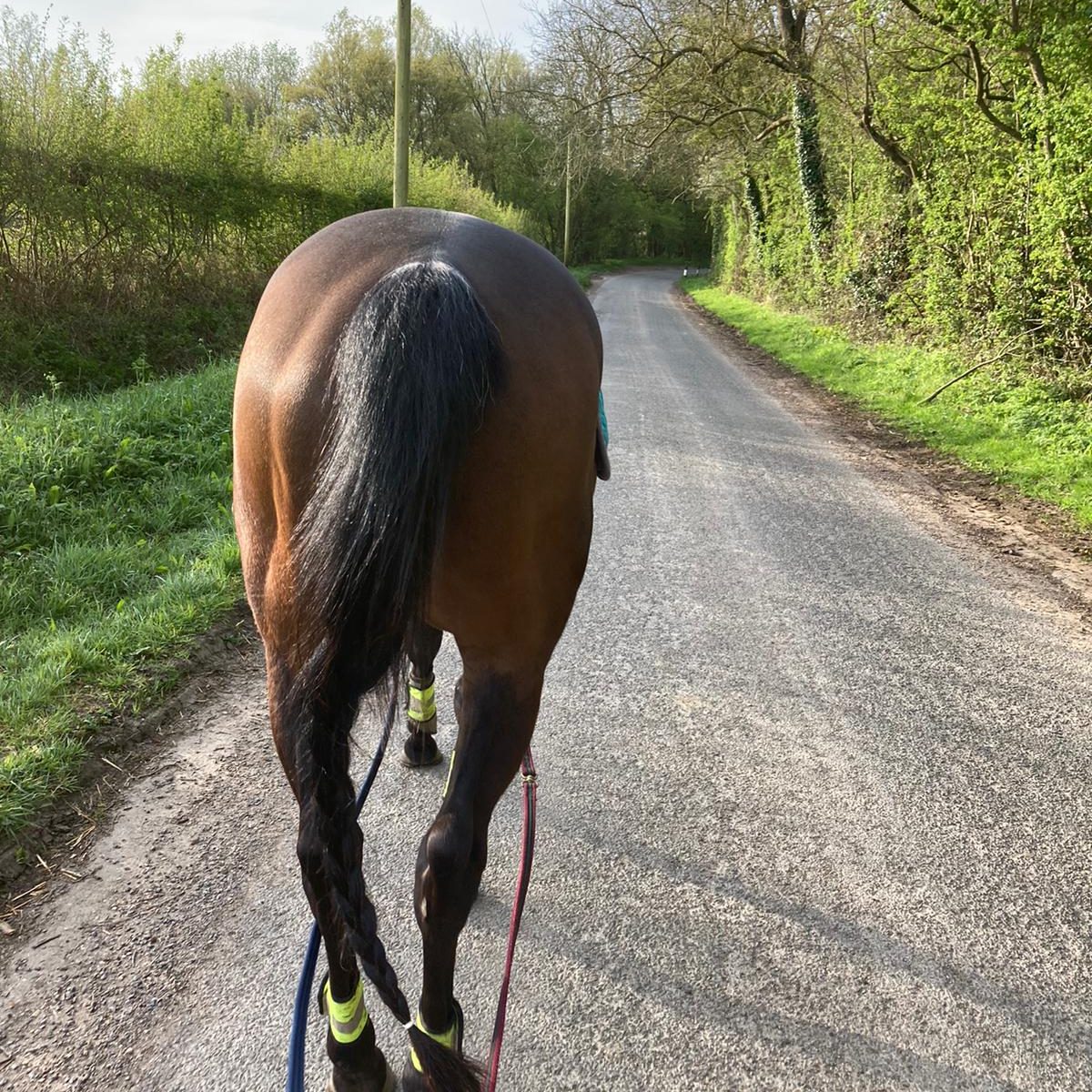
Something we never hope to be doing is rehabilitating our horse from injury. However, horses are incredibly fragile. And at some point, you may find yourself having to cope with a period of box rest and rehabilitation work. I have identified some keys to successful rehabilitation.
There are three key tools that are useful for a successful rehabilitation of a horse to full athletic performance regardless of the injury type:
- A good support team
- Access to tools that will help with rehabilitation work
- A solid plan
The Support Team
The support team is crucial and includes vets, physio, farriers, trainers etc, and good friends. You hopefully will have a good relationship with your vet, physio, and farrier so they all work together to bring your horse back to fitness.
Vets
I have been working with Rossdales for over 15 years and they have looked after my last 3 horses as well as the many horses that I have handled professionally. My current consultant, Sarah Boys-Smith, treated Tarquin for his forelimb suspensory issue and Nickel with his many ailments. She knows my strengths and weaknesses and is great as a sounding board for ideas during the rehabilitation process. My main contact with Rossdales is Lucy Grieve, former BEVA president and my ambulatory vet. She also has known me a long time so is great for contacting with random thoughts and worries. I don’t recommend pestering your vet incessantly but it does help to have a good relationship with the vets so you can stop little problems becoming big ones.
Farriers
The vets also talk to my farrier and physio, so everyone has the same information. This is essential for rehabbing horses that have multiple complex issues like Nickel had and Stormy now has. A good farrier is essential for any competition horse. My current farrier, Iain Nixon was an apprentice when I first met him. He worked alongside my original farrier, Will O’Shaughnessy, who is now too busy for riding horse clients. Will is the lead farrier for Newmarket Equine Hospital and an expert in getting horses sound. A farrier that takes the time to discuss issues and cares is one that you must look after. I always make sure that Stormy is in, with clean dry feet and in an area that is dry so that he can do his job properly.
Physiotherapists
Physios are very much a try it and see from experience. I have had many different ‘back’ people over the years. Mostly I am led by what suits the horse. If I feel an improvement then I stick with that physio, even if I have been sceptical. Nickel for example loved the Chiropractor who was into myofascial release. To me she didn’t look to be doing much, but he was noticeably much improved every session. Currently I am using Kate from Complete Performance Physiotherapy on the recommendation of the vets and as my usual physio was sadly unavailable. She is used to working with racehorses so is very good with Stormy and her little ways!
Dentist and Nutritionist
As well as dealing with the immediate problems your horse may be facing it is important to also keep up to date with your horse’s dental work and nutrition. These are vital for healing, as a horse that cannot eat properly or is on feed that is not providing what they need, will not thrive. Whether you use a dentist, or your vet is purely personal, I prefer to use a dentist.
For my nutrition guidance I do consult a feed company nutritionist. I did study equine nutrition at university but that was a long time ago now! So, to keep up to date I ask for hints and tips. Feeding Stormy has been completely different to feeding Nickel. Currently she is on grass nuts, micronized linseed, and Dengie HiFi Senior (previously Dengie Competition). This has enabled her to have the protein she needs without blowing her head off. She is very reactive to mixed feeds.
Trainer
Even if you are not having lessons or training due to your horse’s injury, I do recommend keeping in touch with your trainer. This has two main roles. Firstly, they can give advice on how to cope with different aspects of rehabilitation. From hand walking to introducing lungeing, which gear might suit your horse in your situation. My trainer came out recently and gave me a lesson in the school all based on in hand work and pole work. She spotted some big gaps in our work and has helped me be more consistent. Secondly, for moral support for yourself. People often forget how draining it is to be rehabbing a horse. Particularly as usually there is no guarantee that after all your hard work that you will get the results you need.
Good Friends
Which brings me nicely onto friends. Be very careful on who you rely on. I have found in my various stints of rehab that some people who you thought were friends are in fact happiness vampires. You do not want someone that is unrealistically positive but also you don’t want someone that is constantly questioning why you are bothering to put in all this hard work.
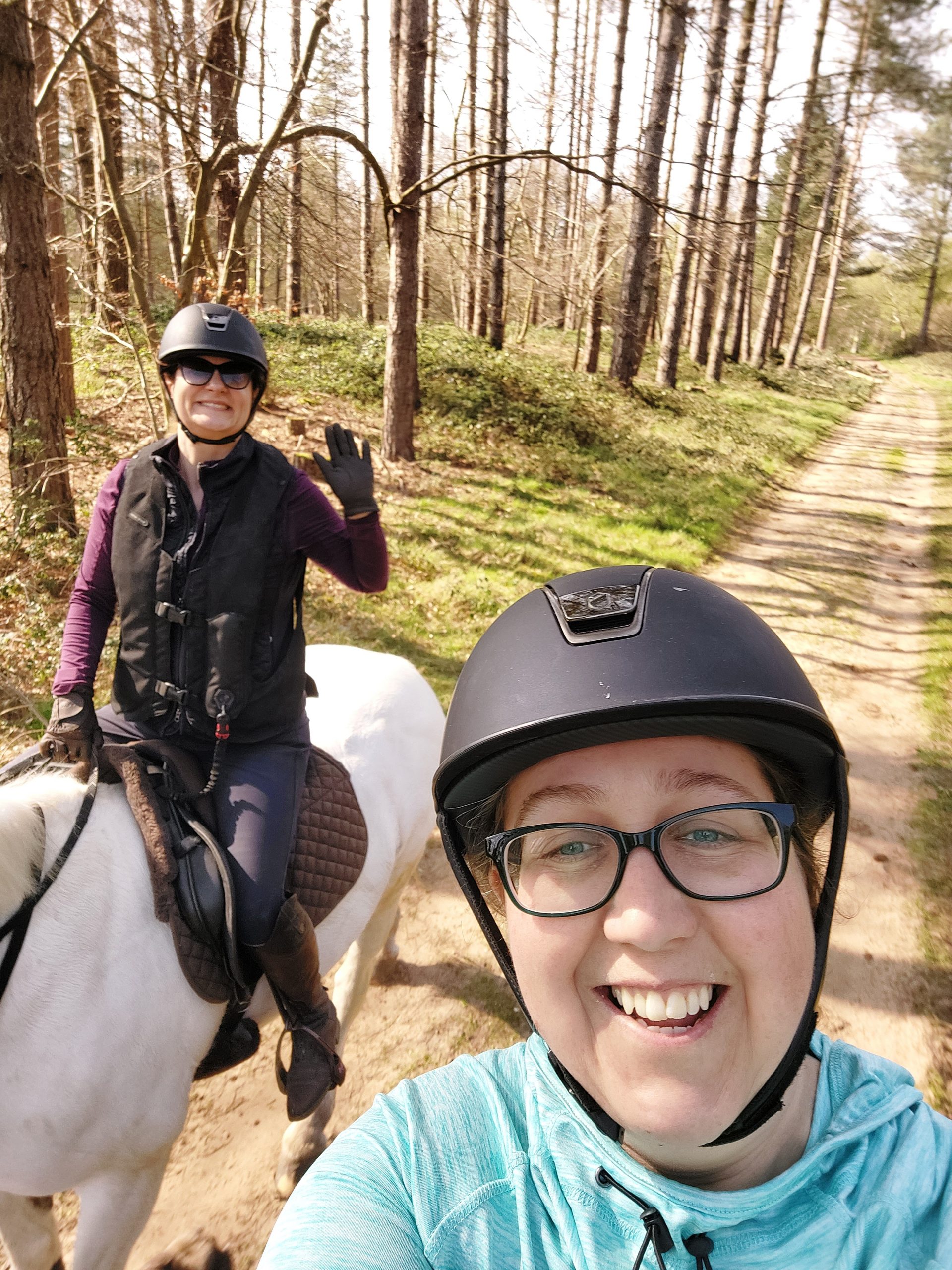
I have a good set of friends that will know everything that is going on and some that have most of the story. This helps deal with people’s expectations of what you are achieving. I also go out and support them with their competing/training etc. If your horse is out for a long time, then it is a good chance to fix yourself or improve aspects of your riding. I have had lessons on the equine simulator at the local equine college, joined a rider fitness programme and ridden other people’s horses. All of this is positive and helps not just physically but mentally.
One note that I would like to put in at this bit is that it is ok to not ride. You will not forget to ride. I was panicking about this, this time as I had had time off for my own surgery and rehab. My trainer reminded me it was better to ride no horses, rather than ones that were not improving my riding. I did ride a few very nice showjumpers of a friend’s before I got back on Stormy as it had been 5 months and it was more for my riding confidence. I had selected these horses as being ‘safe’ and up to the sort of schooling I wanted to test my shoulder on.
Access to Rehabilitation Tools
Depending on what is wrong with your horse, will influence what tools you are using for rehab. Most of us will start with box rest for a period of time. I have been lucky that Stormy has been very good on box rest, Nickel was too. Tarquin, however, was awful. The first day home from hospital, he had a whole tube of Sedalin and his top door shut and still was going mad. This led to some serious ‘out of the box’ thinking, to get him to take the rest he needed.
After box rest, you will have some sort of guidance from your vet as to what you do next –
- Hand-walking
- Long Reining
- Lungeing
- Water therapy – swimming, water treadmill, cold water spa
- Pole work
- In hand work
- Focus types of work i.e., long and low for those with Kissing Spines or work in straight lines for those that have limb injuries.
- Hacking
- Dynamic Mobilisation Exercises
- Appropriate turn out – size, companions etc
As I worked in a rehabilitation yard, I had gained a lot of experience in the appropriate use of all these tools. If you don’t have time, then a good rehab yard is a good idea as one thing you will need lots of is time.
It is possible to rehabilitate a horse without an arena and in some ways an arena is the last thing you will need. However, this is assuming your horse is quiet enough and confident outside. A lot of rehabbing is a compromise, and you should never feel bad that you can’t do everything to the letter of the vets. If you do the best you can and ask for help then you are doing the right thing.
There are many resources out there to help with all the tools above. YouTube is useful. I am starting to produce a series of videos that should the very simple examples of what a good walk should look like when working in hand etc. So, pop over to my channel for those (if you subscribe then you will never miss out).
A Solid Plan
The road to recovery is not a fixed period. I have found the best way to keep track of what I am doing and where we are heading is to use my Weekly Rehabilitation Worksheets and my undated Journal. This also was good to be able to show to the different professionals that are treating Stormy so they can see where we are at.
I have also found that using a planner that I created on Google Sheets have been essential. On that I recorded my aims for walking, then trot work. I have got all my appointments on there, what work we did and what we have planned. As it is on Sheets, I also have access to it on my phone. I constantly update it, so it is a very accurate record of what we are up to.
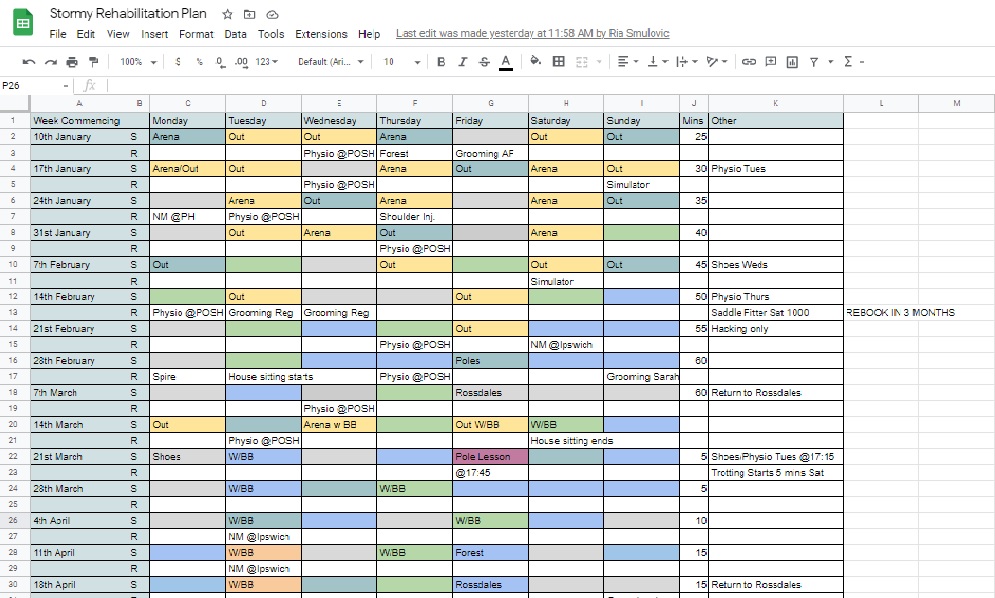
Having a plan outlined helps massively with motivation and this is one of the hardest parts of dealing with rehabbing a horse. I have found that at some points, it is nothing but a hard slog. After all, you cannot explain to the horse why you are doing things the way you are. Sometimes the weather is awful, or you have setbacks. Other times, it is depressing to see your friends going out enjoying themselves while you heading to vets for yet another check-up.
I have put together a package for people that are either working their horses up from injury or for those that need help with a fitness plan. You can find more information here. It’s a bespoke service and I have limited the number that I offer at any time. It includes a detailed plan that we can go over together and tweak for the entirety of the plan. Lesson plans for pole work and more to be added along the way. You can also add in Zoom calls to help with additional questions or motivation. I believe as someone with practical and personal experience of rehabilitation that I can really help motivate and assist anyone on their horse’s road to recovery.
The End of The Road?
One thing that I have learnt over the years is that even when your horse is back to full fitness, often recovery never truly ends. Nickel pretty much was in a form of rehab of one sort or another for 10 years. The best way to really think about this is that through your initial rehab you are learning a new way of working your horse that you will then follow for the rest of their career.
I have been very lucky in that my horses have all come back to some form of useful work. However, I am now very philosophical. With Stormy, we are a long way off, but as she has proved that she can go on trips to the Forest and is a good hack. So, if she does not compete, I am committed to keeping up all her rehab work so we can keep going on adventures. Competitive or for pleasure.