We’ve all been there. Your horse has spent weeks, often months, confined to a 12×12 box. You’ve meticulously soaked hay, swept up a mountain of bedding, sweated through hand-walking sessions, and watched your bank account drain into vet bills. Finally, the day arrives. The vet gives you the green light for turnout.
You should be thrilled, but this is just the start of the next part of the nightmare.
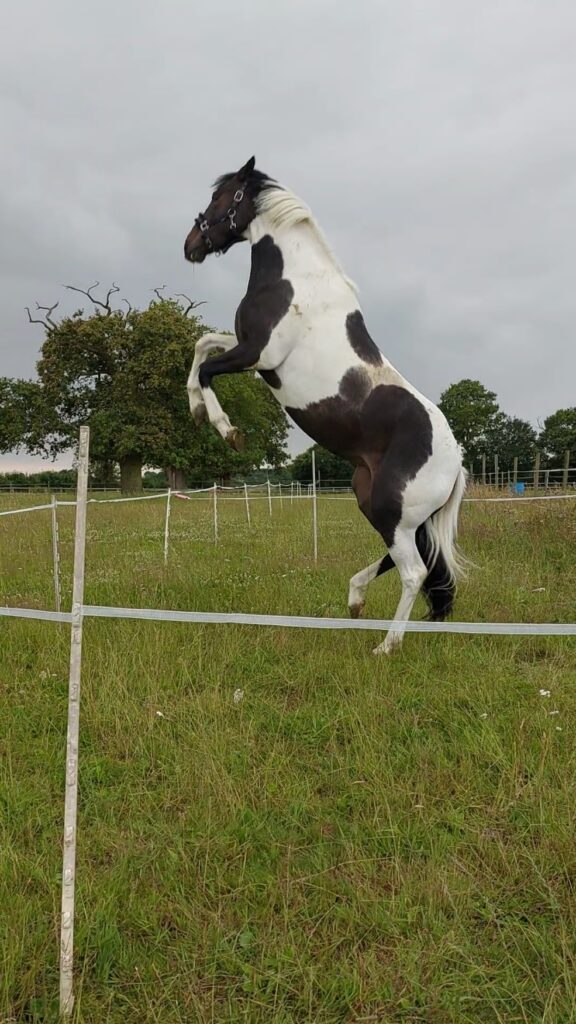
You know exactly what’s about to happen the moment that headcollar comes off. One explosive leap, a buck that defies gravity, and a massive sliding stop at the fence line that risks undoing months of careful healing in a matter of seconds. It’s the ultimate catch-22 of horse ownership: they need to go out for their brain, but their brain, or lack thereof makes going out a hazard to their health.
The Livery Yard Reality Check
When you’re managing elite competition horses or racehorses in professional rehab facilities, you often have access to custom-built turnout cages, safe rubber flooring, and staff on hand 24/7. But when you are a leisure horse owner on a busy livery yard, the reality is very different. You have to work with the fields you have, you can’t build permanent structures, and you certainly don’t want to get on the wrong side of your yard manager.
So, how do you get a difficult, incredibly “fresh” horse safely from the stable back into the field without relying on heavy sedation forever?
As someone with a BSc (Hons) in Equine Science and 20 years of experience managing Thoroughbreds through every stage of life, including a lot of intensive rehab, I used to think I’d seen it all. But recently, while rehabbing my own mare, Rosie, from a serious ligament injury, I faced a turnout challenge that made me rethink everything.
The solution wasn’t a smaller pen, a longer lead rope, or crossing my fingers. It was a clever, science-backed setup that forces the horse’s brain to slow their body down naturally.
The “Maze” Paddock System: Slowing the Body by Engaging the Brain
When a horse has been locked up for months, their natural instinct upon entering a field is to sprint in a straight line and execute a massive sliding stop when they run out of room. If your horse is recovering from a tendon or ligament injury, those sudden, jarring stops are exactly what we need to avoid.
Your first instinct might be to build a tiny, square turnout pen. But standard small pens can actually cause more harm than good for certain injuries. A cramped square often forces a fresh horse to spin tightly on their hocks or turn sharply. This puts immense twist and strain on healing limbs.
Instead of restricting their space into a box, we need to change how they navigate that space. That is where the “Maze” system comes in.
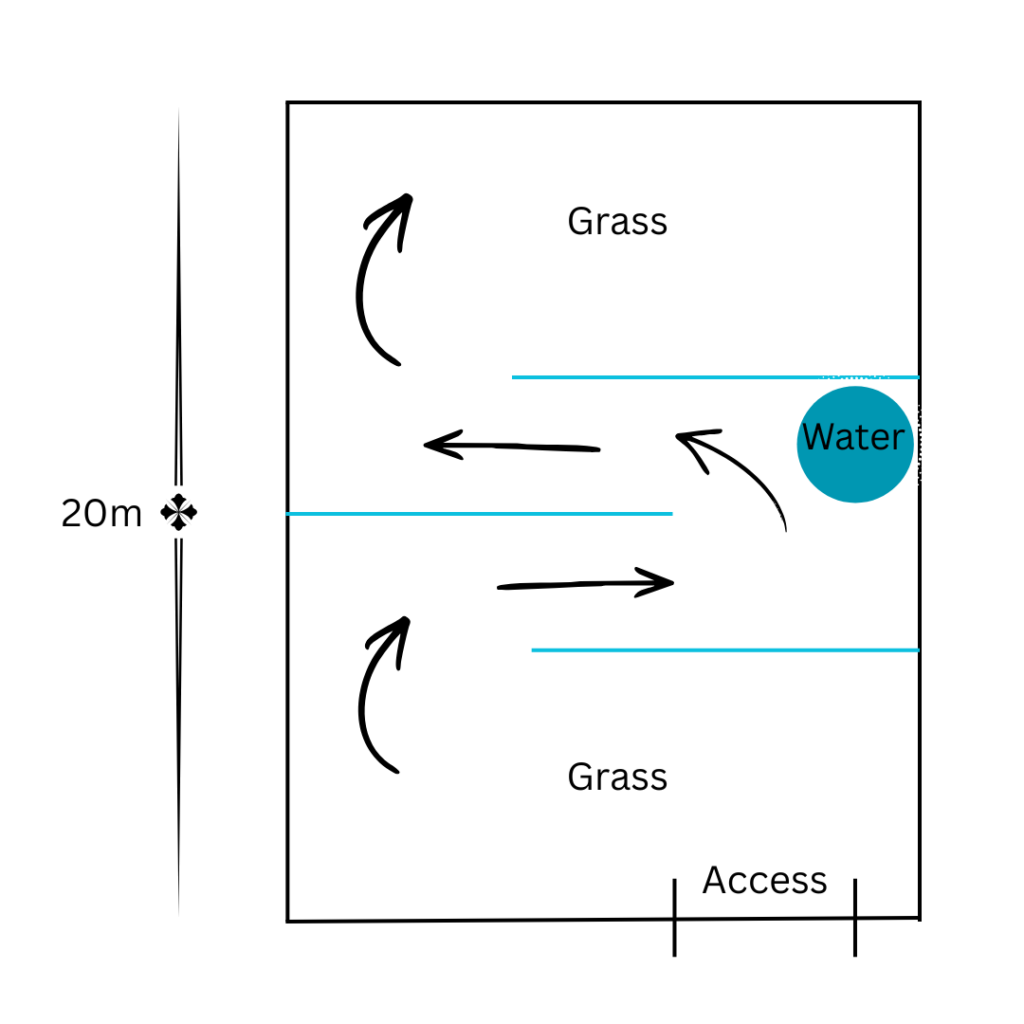
The system is built entirely from temporary electric fencing and involves creating two larger squares connected by a series of interlinking, zig-zagging lanes. By breaking up the straight lines of a traditional paddock, you completely remove the runway.
The Science Behind the Maze
As an equine scientist, what I love most about this setup is that it isn’t just a clever husbandry trick. It aligns perfectly with veterinary sports medicine and rehabilitation frameworks:
- Neuro-Muscular Stimulation & Proprioception: When a horse is on box rest, their nervous system “forgets” how to properly coordinate limb placement because their environment is completely flat and static. Walking a slow, winding maze forces the horse to look down, process spatial changes, and make highly precise, micro-postural adjustments. This actively fires their core muscles and stabilizes the spine without high-impact strain.
- Lateral Bending as Passive Physical Therapy: Straight-line movement allows a fresh horse to stiffen their spine and hollow their back. The tight, controlled changes of direction inside a labyrinth require immediate lateral flexion (bending through the ribcage). This stretches the long back muscles and activates the deep pelvic stabilizers, gently restoring a safe range of motion to healing soft tissues.
- The Shift from Flight to Focus: Neurologically, a horse in an open paddock relies on rhythmic, automated gaits (flight mode). Introducing a complex visual layout like a maze triggers a cognitive problem-solving response in the brain. It quite literally switches their mindset from “sprint and slide” to “where do I put my feet next?”
The Step-by-Step Setup and Progression
- The Starting Size: When you first set up the maze, keep the overall dimensions relatively compact. I think of matching the total area to the size of a couple of stables so 20m x 10m.
- Strategic Placement: Place their water bucket either at the furthest point of the maze or in the middle of the maze. This incentivizes them to quieten down and negotiate the lanes slowly to get a drink.
- The Slow Move Up: Start by letting them graze the first section. As they clear the grass, you move the entire maze up the field line by line. This gives them access to fresh grass daily without actually increasing their speed lane. This also prevents boredom or excessive weight gain.
- Widening the Lanes: Over a period of about a month, as your horse settles into a routine and becomes less “fresh,” you can gradually widen the lanes and add more sections. Eventually, they transition seamlessly back to full turnout.
Using this exact method, my mare Rosie went from requiring sedation just to stand in a small pen to being completely relaxed, out overnight, and eventually making a 100% full recovery. Best of all, it requires very little gear, you can build it by yourself, and it doesn’t get in the way of other livery yard users.
Bringing It All Together
Rehabilitating a horse is a test of patience, dedication, and emotional endurance. When you are on a busy livery yard, the pressure to keep your horse safe while respecting yard boundaries can feel overwhelming. But successful rehab isn’t about forcing a horse into absolute stillness. It is about managing how they move.
The “Maze” system gives you a practical, stress-free tool to transition your horse back to the field safely. It protects their healing limbs, saves your sanity, and gives them back the freedom they’ve missed.
Watch the Maze in Action
If you want a visual guide on exactly how to thread these lanes together and see how my mare Rosie settled into the rhythm of the grid, watch my full tutorial video below:
👉 Watch the Box Rest to Field Turnout Tutorial on YouTube
Don’t forget to hit the Subscribe button while you’re there! I’ll be sharing more evidence-based, real-world horse care tips to help you navigate everything from foaling to fitness.